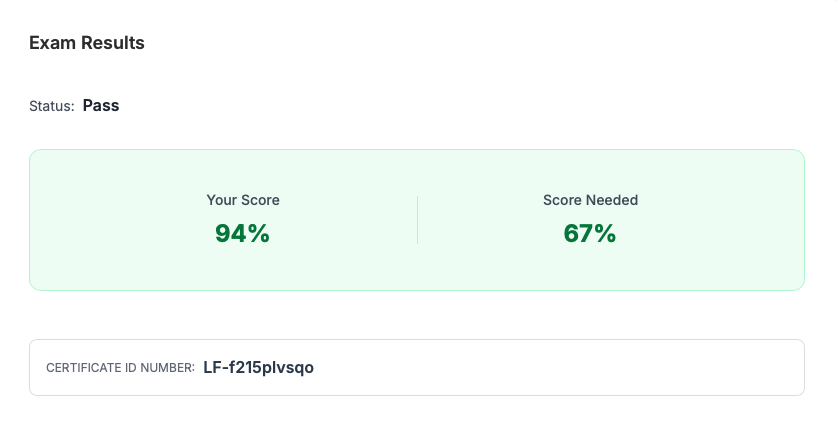
In this article, I will demonstrate how I tackled the CKS exam, the strategies I followed, the materials I have used and finally I will give you some tips and secrets to pass with a 94% score.
This article will guide you through the following topics:
- General Exam Information to Know
- Exam content
- Resources I have been using
- Secrets and Tips
- My personal thoughts
General Exam Information
The Kubernetes Certified Security Specialist is the toughest exam among the five Kubernetes CNCF certifications. To pass this exam, you must only have a valid CKA certification. If you are not prepared for the CKS, you should, for a 2-hour-hands-on exam (no multiple-choice or quiz), you will need to use a present architecture or run a Kubernetes cluster node and test your ability to secure maintain cluster applications and Kubernetes security-relevant installation, hardening, and runtime phases. It costs $445 as of today.
Exam Content and Weightings
1. Cluster Setup (10%)
- Secure Kubernetes cluster installation and configuration
- Use of scan detection for cluster: API server, etcd etc
- Implement network policies and secure communications (mounts TLS certificates)
2. Cluster Hardening (15%)
- Restrict access to Kubernetes API
- Manage RBAC; root minimum-user and service account privileges
- Defense admission controls and related anonymous access
3. System Hardening (15%)
- Secure host OS footprint (not OS hardened-specific policy enforcers)
- Minimize control/attack surface
- Use Linux security tools (AppArmor, seccomp, etc.)
4. Minimize Microservice Vulnerabilities (20%)
- Apply zero-site, control-layer defenses
- Scan container images for vulnerabilities
- Manage secrets properly and avoid hardcoding sensitive data
- Use mTLS links / tags and misconfiguration tools
5. Supply Chain Security (20%)
- Verify image integrity and provenance (e.g., signing images)
- Implement image policies and admission controllers
- Manage OCI; artifact security per Artifacts) static CI/CD: tools
6. Monitoring, Logging, and Runtime Security (20%)
- Detect threats and abnormal behavior in containers and clusters
- Attacker and high-API server activity and kubelet traffic
- Apply on timer protection (e.g. Falco, AppArmor, seccomp profiles)
Some Topics That You Could Get on the Exam
- Creating and executing AppArmor
- Implement any role minimum model (YAML)
- Implementing and Figma kubernetes Policies
- Securing the Docker application environment secrets
- Upgrading the api server etcd Admission controllers specific use
- Manual Scanning for manifests
- Service Account management
- TLS termination review
- Applying Security best practices on Runtime/worker and other components
- ImagePolicyWebhook setup
- Kubernetes auditing
The Resources That I Have Used
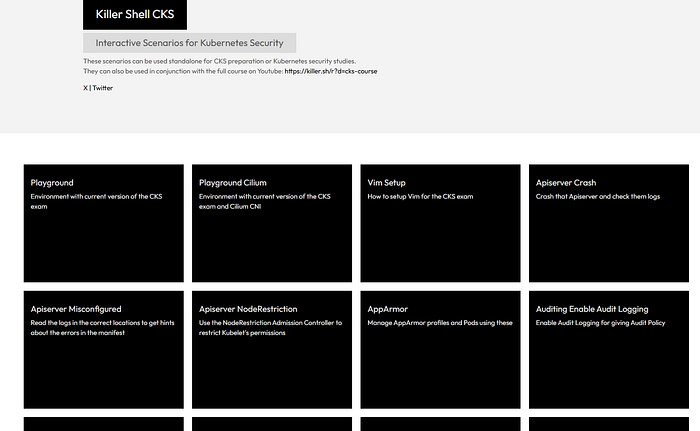
Killer.sh once more gives you some of the best resources available for gaining the knowledge needed to pass the Certified Kubernetes Security Specialist (CKS) exam.
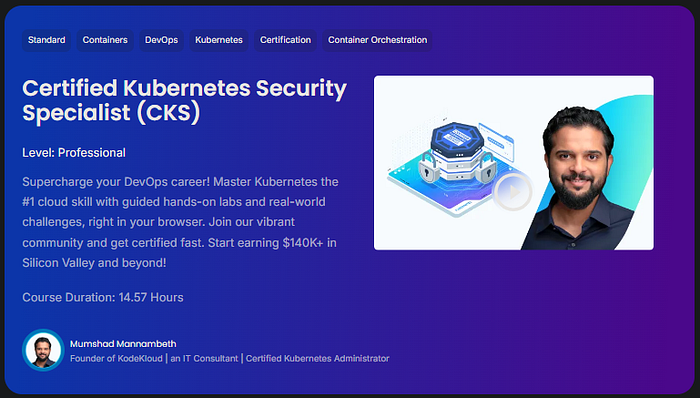
KodeKloud is designed for professionals looking to master security in Kubernetes-based cloud-native environments, and become the Certified Kubernetes Security Specialist. It is aligned with the latest CKS exam domains, including cluster setup/hardening, system hardening, microservice vulnerabilities, software supply-chain security, runtime monitoring and threat detection.
Killercoda Interactive Environment: As I mentioned in my CKA article, these interactive labs will provide you with excellent hands-on experience.
Tips and Secrets
1. Know Your Final Enemy
- You have 2 hours to do 15-20 hands on tasks.
- You must be fast and precise — not perfect. If something takes too long, skip and come back.
- You have your own notes via a URL max.
2. Create a Secret Alias Cheat Sheet
Before the exam begins, you are allowed to:
- Create aliases like:
alias k=kubectl
alias kgp='k get pods'
alias kns='kubectl config set-context --current --namespace'- Enable auto completion:
source <(kubectl completion bash)
complete -o default -F __start_kubectl k- Use export for faster terminal editing:
export do='--dry-run=client -o yaml'3. Learn how to Scratch Kubernetes Docs FAST
You are allowed to use official Kubernetes docs.
4. Aim for Accuracy, not Perfection
In the CKS exam, your goal is to pass — not to solve every question flawlessly. Trying to be perfect on every task can actually make you fail, because:
- Time is limited and extremely valuable — spending 15 minutes perfecting a single YAML file might cost you time to enter into other questions worth more points.
- The exam is graded by total points, not by perfect on every task.
- Some questions are hard on purpose — they’re meant to test deep knowledge, but you don’t need to get them all correct to pass.
How to — completely understanding how important realistic preparation would be:
I became extremely conservative. All my preparations, the schedule, the exam, and even after waiting for the results — when I considered everything myself, my approach, and I did just the 66 and not much else.
Ultimately, shifting my perspective to ‘an unready’ failure not as a defeat, but as part of the learning process, changed everything. It allowed me to stay composed, focused, and confident enough to actually succeed.
My Overall Thoughts of the Experience
It was a rewarding and extreme journey that allowed me to dive deeper into Kubernetes security and discover new layers of security and understanding Kubernetes clusters.
You need also to be prepared for failure since it is okay to learn more and you do not feel bad about it yourself. If you fail one time or more, more taking this exam.
Exam Results
Was this helpful? Confusing? If you have any questions, feel free to contact me!
Before you leave:
👏 Clap for the story